Indoor Rabbit Cage Guide: Size, Setup and What Goes Inside
An indoor rabbit cage should be at least four times as long as your rabbit when it is stretched out, tall enough for it to stand on its back legs without its ears touching the top, and solid underfoot. Just as important: the cage is a base, not a whole home. Rabbits need a much bigger area to run in every day, ideally joined right onto the cage.
Most cages sold as "rabbit cages" are smaller than welfare groups recommend. This guide gives you the numbers, a quick way to measure your own rabbit, the features worth paying for, and a setup checklist so the cage works for your rabbit rather than against it.
How big should an indoor rabbit cage be?
PetMD's vet-written cage guide says a cage should be at least four times the length of your rabbit, tall enough for it to hop and stand on its hind legs, and double the recommended space for each extra rabbit. Its minimums:
| Rabbit size | Minimum cage (W x H x L) |
|---|---|
| Small breeds (Dwarf, Dutch) | 24 x 24 x 36 inches |
| Giant breeds (Flemish Giant) | 36 x 36 x 120 inches |
| Two or more rabbits | Double the space per rabbit |
Those are floors, not targets. VCA Animal Hospitals sums it up bluntly: "the biggest cage you can afford is too small!" The RSPCA gives a simple test that works for any setup: your rabbit should be able to stand on its hind legs without its ears touching the roof, lie fully stretched out, and turn around freely.
The UK's Rabbit Welfare Association & Fund sets the bar higher still, calling for a single enclosed area of at least 3m x 2m by 1m high (about 9'10" x 6'7" x 3'3"), with the sleeping quarters allowed to count as part of it. No cage on the market is that big, which is why the setup below pairs a cage with a pen.
Worked example: measure your own rabbit
- Wait until your rabbit is lying stretched out, and estimate nose to tail. Say it is 16 inches.
- Multiply by four for the minimum length: 16 x 4 = 64 inches, or just over 5 feet.
- Measure it sitting upright on its back legs, ears included, and add a few inches for the height.
- Still growing? Use the adult size of the breed, not today's size.
If the cage you like is shorter than that number, either look for a large indoor rabbit cage or skip the cage and use a pen as the main enclosure.
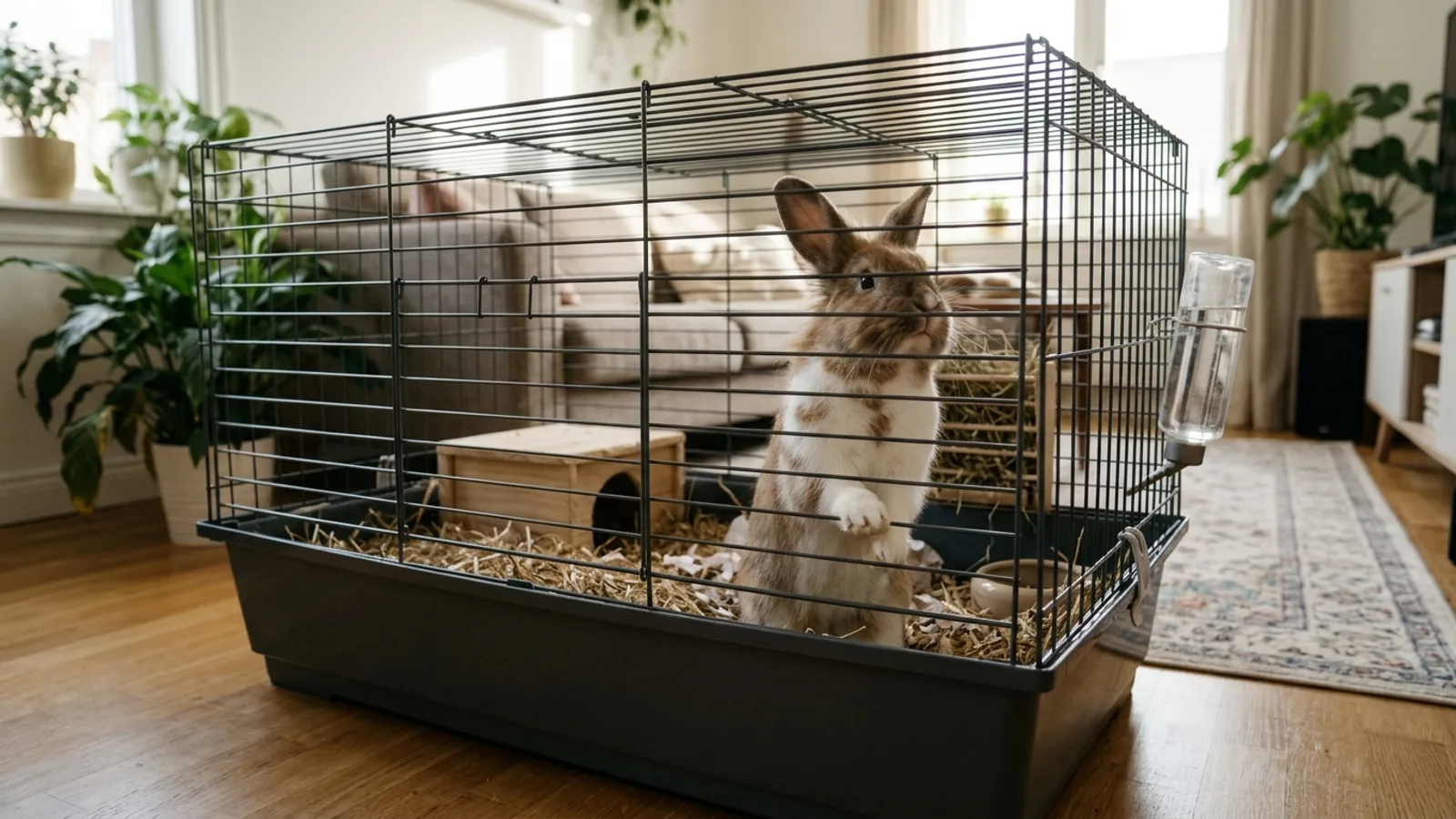
Features that matter when choosing indoor rabbit cages
- A solid floor. PetMD recommends solid flooring such as plastic. Wire floors can hurt feet; the RSPCA says floors should be solid and non-slip, not wire or barred, because wire can injure feet and hocks. If a cage has a wire base, VCA says at least half of it should be covered with something solid, and PetMD suggests fleece plus a thick layer of paper bedding.
- Wire sides, not wood. PetMD recommends wire sides for airflow and warns that rabbits tend to chew wood.
- Safe bar spacing. The Rabbit Welfare Association advises covering the bars of dog crates and puppy pens with mesh so a rabbit cannot trap a leg or head.
- A big door. Your rabbit should be able to hop in and out on its own, and you need to fit a litter tray through it.
- A deep, removable base tray that makes daily spot-cleaning quick.
Avoid multi-level hutches that look roomy but have tiny floors on each level. Floor area is what lets a rabbit hop.
Where to put the cage in your home
The RSPCA recommends a quiet room away from noisy appliances, and a temperature between 10°C and 20°C (50–68°F), away from draughts, radiators and fires. PetMD suggests a well-ventilated spot out of direct sunlight, somewhere your rabbit sees you often, at 60–75°F. VCA warns that rabbits are very sensitive to heatstroke and should be kept at or below 80°F (26°C).
In practice, a corner of a living room or home office that people use every day, away from a sunny window and the TV speakers, suits most rabbits. A busy hallway or a quiet spare room nobody visits does not.
What goes inside: the setup checklist
- Litter tray. The RSPCA suggests newspaper, hay or straw, shredded paper, or paper-based non-clumping cat litter. The Rabbit Welfare Association says to avoid clay-based and pine products.
- Hay, next to the tray. The Rabbit Welfare Association recommends placing hay beside the litter tray. Hay is the bulk of the diet, as our guide to safe foods for rabbits explains.
- Water. PetMD suggests a bottle or a heavy ceramic bowl that will not tip.
- A hide. The RSPCA recommends one hide per rabbit plus one extra, each with more than one opening. A cardboard box with a hole cut at each end works well.
- Soft, non-slip flooring such as fleece or a washable mat over the base.
- Chew and dig options. PetMD lists applewood sticks, hay chews, tunnels and dig boxes; the RSPCA suggests a digging box for indoor rabbits.
- Space to move. After the items above go in, your rabbit should still be able to stretch out and turn around. If not, the cage is too small.
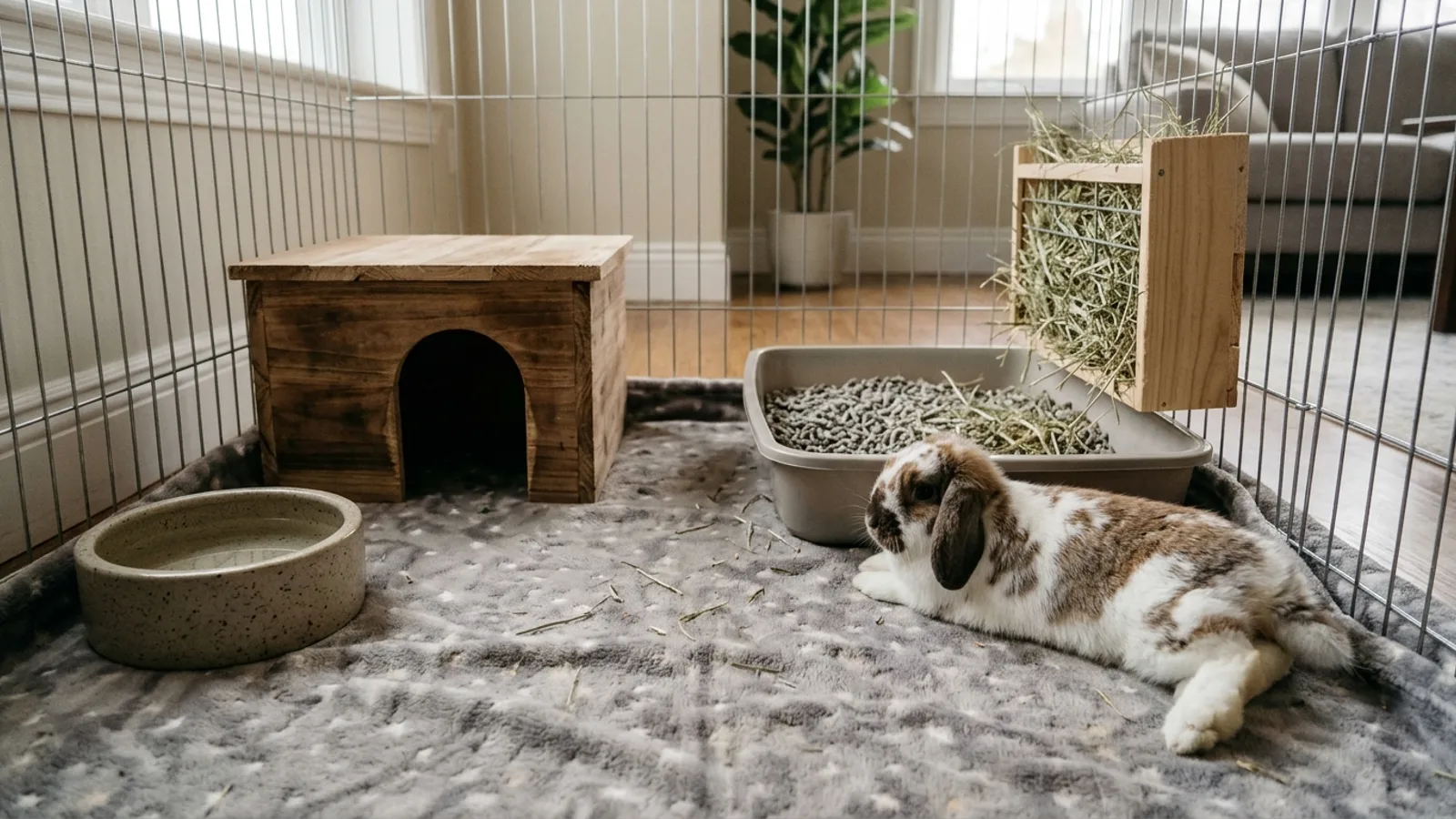
The cage is a bedroom: add an exercise pen
The RSPCA says a rabbit's exercise area should be permanently attached to its shelter and accessible at all times, ideally 24/7. VCA calls a playpen "highly recommended" so a rabbit can stretch and move without reaching furniture or wires. The easiest way to do that indoors is to leave the cage door open inside a wire exercise pen, so the cage becomes the bedroom and toilet, and the pen becomes the living room.
Outside the pen, the Rabbit Welfare Association's rabbit-proofing advice covers the basics: assume every houseplant is poisonous and move it out of reach, cover exposed cables with cable protector or hosepipe, block access to skirting boards and furniture legs, and supervise free-roaming time. If you grow vegetables indoors or on a balcony, our tomato plant guide lists common plants to keep away from rabbits.
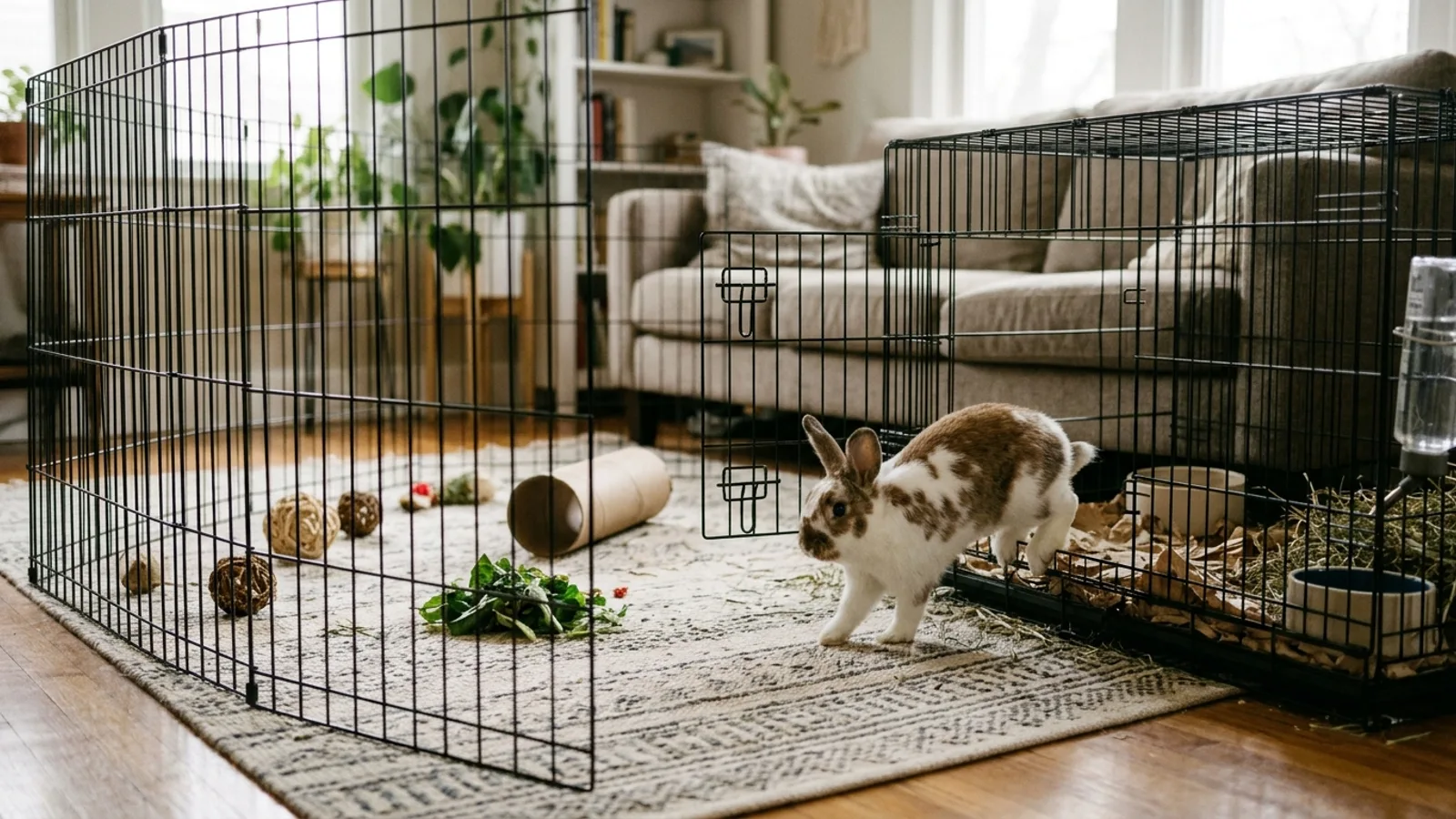
Common mistakes with rabbit cages
- Buying for the baby, not the adult. A cage that fits a 10-week-old bunny will be cramped within months.
- Keeping the rabbit shut in all day. A cage alone, without daily run time, is not enough space by any of the standards above.
- Bare wire floors. Cover them or choose a solid base.
- Bleaching the litter tray. The Rabbit Welfare Association says bleach removes the smell rabbits use to recognise their tray.
- One rabbit alone. The same group says house rabbits need at least one other rabbit for company, which also means planning for a bigger cage.
Cleaning routine
PetMD's routine: every day, remove soiled litter, refresh food and water, and top up bedding. Every week, move your rabbit to a safe play area, empty everything, wash the dishes, clean surfaces with a pet-safe product, rinse, dry and refill. The RSPCA gives the same rhythm: toilet areas daily, the whole enclosure about once a week.
Frequently asked questions
Is a cage cruel for a rabbit?
A cage on its own is too small for a rabbit to live in full time. Used as a base with the door open into a large pen or a rabbit-proofed room, it gives a rabbit a familiar place to eat, toilet and rest.
How many hours should my rabbit be out of the cage?
The RSPCA recommends that the exercise area be attached and open at all times. If that is not possible, give as much daily run time as you can, especially in the early morning and late afternoon, which the RSPCA notes are among the times rabbits are most active.
Can I use a dog crate as an indoor rabbit cage?
Yes, a large dog crate can work if the floor is covered and solid. The Rabbit Welfare Association advises covering the bars with mesh so a rabbit cannot trap its head or a leg.
What is the best bedding for an indoor rabbit cage?
PetMD suggests paper-based bedding 1–2 inches deep. Avoid clay or pine litter, and use fleece or a washable mat on top of any hard or slippery base.
The takeaway
A good indoor rabbit cage is long enough for four times your rabbit's stretched-out length, tall enough to stand up in, solid underfoot, and opened every day into a much bigger exercise area. Your next step: measure your rabbit tonight using the worked example above, then compare that number with the cage you have or plan to buy.