Rabbit Care for Beginners: Housing, Food, Health and Habits
Rabbit care for beginners comes down to four things: lots of space, a diet that is mostly hay, a friend of their own kind, and a vet who knows rabbits. Get those right and most of the common problems never start.
Rabbits are often sold as "easy starter pets," but they are complex animals with real needs. This guide covers what a first-time owner needs to know, in the order you'll need it: setting up, feeding, litter training, handling, and health. It ends with a daily and weekly checklist you can stick on the fridge.
Before you bring a rabbit home
A rabbit is a long commitment. A Royal Veterinary College study of 6,349 pet rabbits found an average lifespan of 4.3 years, but rabbits in the study lived up to 14.4 years. The researchers linked many early deaths to preventable problems, which is exactly what good care is for.
Plan for two rabbits, not one. The Rabbit Welfare Association & Fund says a house rabbit needs at least one other rabbit for company, and the RSPCA (UK) describes rabbits as social animals that need a compatible companion. A neutered male and female pair is a common and stable combination.
Housing: more space than you think
The biggest beginner mistake is a small pet-store cage. The Rabbit Welfare Association recommends one enclosed area of at least 3 m x 2 m and 1 m high (about 10 ft x 6.5 ft x 3.3 ft) for a pair, and the sleeping area can be part of that. The RSPCA (UK) adds that rabbits should be able to stand fully upright and turn around in every part of their housing.
In practice, most indoor owners combine a base with an exercise pen, or use a pen or a rabbit-proofed room on its own. Our guides to the indoor rabbit cage and the rabbit pen walk through sizes and setup step by step.
- Hides: the RSPCA suggests as many hiding places as there are rabbits, plus one extra.
- Temperature: the RSPCA gives 10–20°C (50–68°F) as the ideal range, so keep rabbits away from radiators, sunny windows and drafts.
- Rabbit-proofing: rabbits chew. The Rabbit Welfare Association says your home needs protecting from chewing for the rabbit's whole life, starting with covering cables.
- Exercise time: rabbits are most active in the early morning, late afternoon and overnight (RSPCA), so give access to their run at those times.

Feeding: the 85-10-5 rule
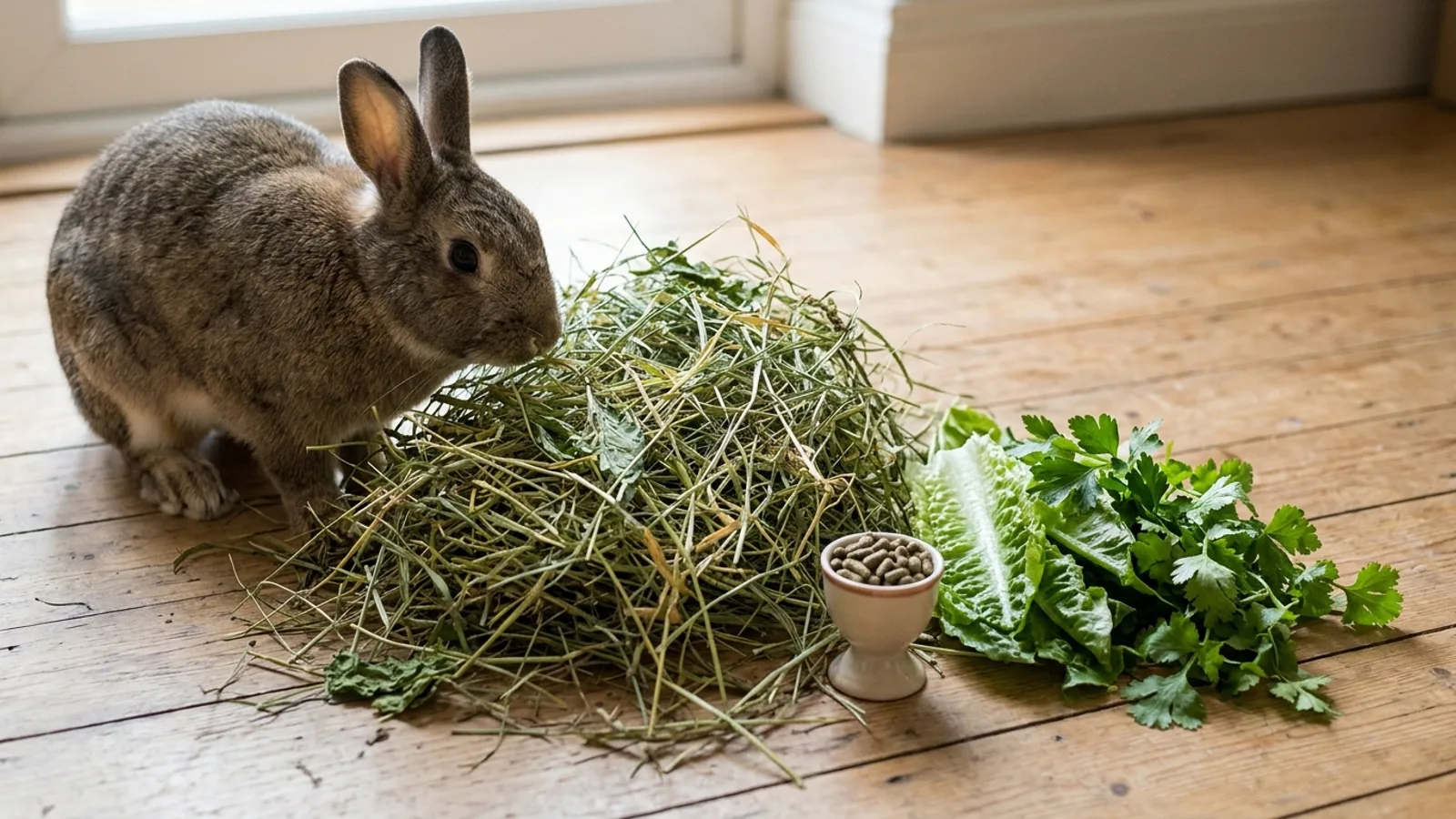
Hay is not a side dish; it is the meal. The RSPCA (UK) breaks a healthy rabbit diet down like this:
| Food | Share of the diet | How much, in practice |
|---|---|---|
| Hay and grass | About 85% | A bundle at least as big as your rabbit, every day |
| Leafy greens, herbs and weeds | About 10% | A large handful of safe, washed greens daily |
| Pellets (nuggets) | About 5% | About 25 g (an egg cup) per kg of body weight |
| Fruit and sweet veg | Treat only | Occasional small pieces |
Fresh water should always be available. Hay matters for the teeth as well as the gut: the RSPCA's rabbit health page says a rabbit's front teeth grow around 2–3 mm each week, and a high-fiber, hay-based diet is the main way to prevent dental disease. For which greens are safe, see our list of safe foods for rabbits.
Introduce new vegetables one at a time. Rabbit.org (House Rabbit Society) suggests adding one new type per day and waiting 24 hours to check for soft droppings or gas.
Litter training and cleaning
Most rabbits learn to use a litter tray, especially once neutered. The Rabbit Welfare Association notes neutered rabbits are easier to litter train. Put the tray where your rabbit already goes, and add hay on top or at one end: Rabbit.org's litter training guide recommends topping the litter with fresh hay to encourage your rabbit to use the box consistently.
- Use: paper-based litter or compressed paper or wood-pulp pellets.
- Avoid: clay or clumping cat litter, which Rabbit.org says can cause intestinal blockages if eaten, and pine or cedar shavings, which contain aromatic oils.
- Clean: the RSPCA (UK) says toilet areas should be cleaned every day.
Handling and building trust
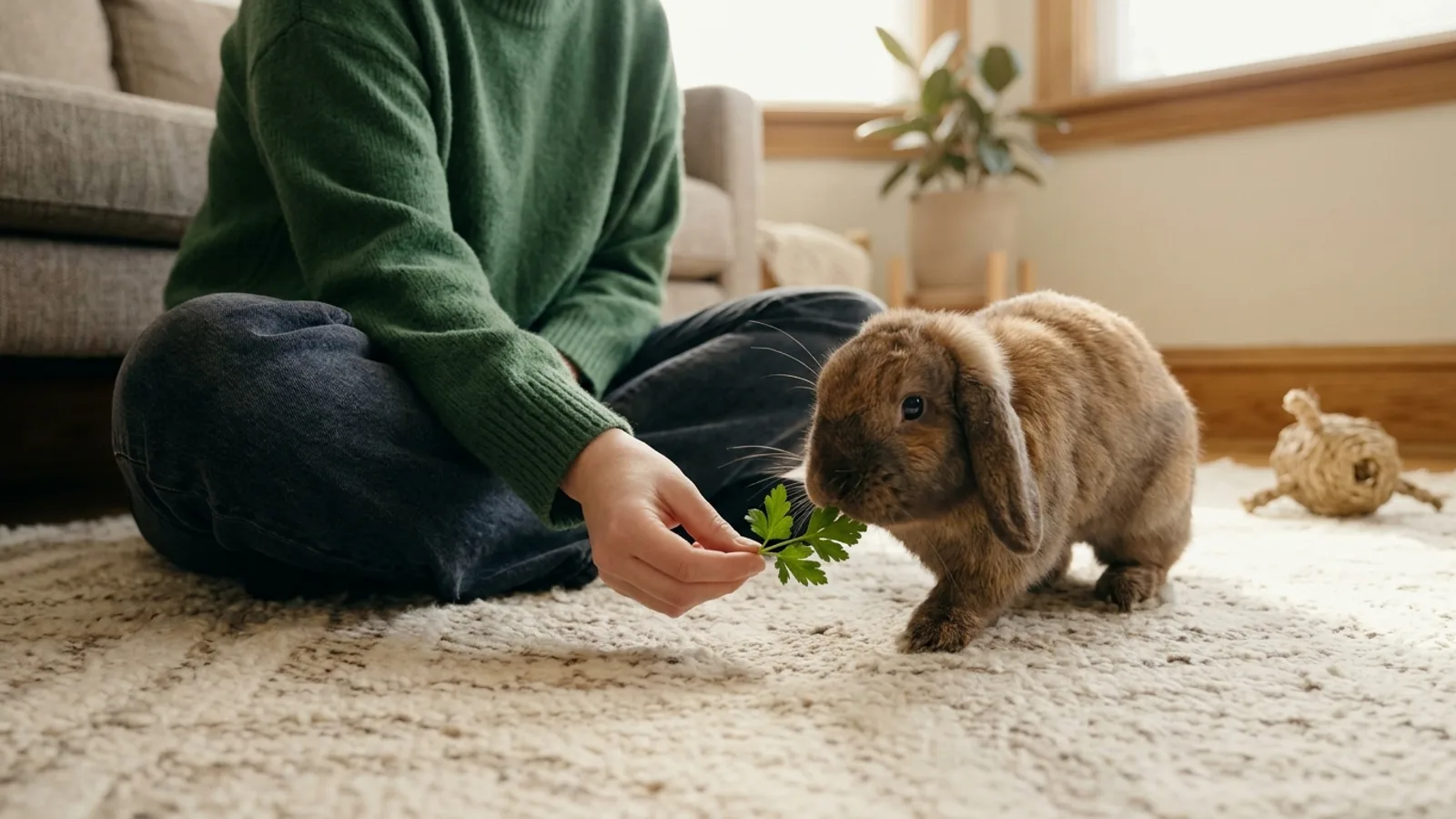
Rabbits are prey animals, and being lifted feels like being caught. The RSPCA (UK) advises doing routine interaction, health checks and grooming with all four of the rabbit's feet on a stable surface, and never turning a rabbit onto its back to "calm" it: rabbits show signs of stress and fear before, during and after being turned over.
Instead, sit on the floor and let your rabbit come to you. Offer a herb from your hand, stroke the forehead and back, and stop when your rabbit moves away. Trust built this way lasts. If your new rabbit nips or lunges, that is usually fear, not bad temper.
Health basics: vet, neutering and vaccines
Find a vet who treats rabbits before you need one. The Merck Veterinary Manual recommends a vet exam when you first get a rabbit and once a year after that, including a check of the teeth.
- Neutering: Merck says spaying females removes the risk of uterine cancer, which is common and often fatal in rabbits over 3 years old, and neutering males helps reduce aggression and urine spraying. The Rabbit Welfare Association recommends neutering both sexes, ideally by 6 months of age. Your vet will advise on timing.
- Vaccines: in the US, Merck lists the vaccine against rabbit hemorrhagic disease (RHDV2) as the one routine vaccine for pet rabbits. In the UK, the RSPCA lists vaccines for myxomatosis and both strains of rabbit hemorrhagic disease. Ask your vet which apply where you live.
- Nails and coat: Merck suggests trimming nails every 1–2 months and brushing short-haired rabbits twice a week (long-haired rabbits daily). Overgrown nails were the most common problem in the RVC study, affecting 16% of rabbits.
- Flystrike: the most common cause of death in the RVC study (10.9%). The RSPCA advises checking the fur around your rabbit's rear end twice a day in warm weather.
Emergencies: a rabbit that stops eating or passes fewer or no droppings may have gut stasis. The RSPCA says this can quickly become life-threatening and to see a vet immediately.
Rabbit care for beginners: daily and weekly checklist
This is the part of the rabbit care guide to print out. It turns the advice above into a routine.
| When | Task |
|---|---|
| Every day | Refill hay (a pile as big as your rabbit) and fresh water |
| Every day | Serve a handful of washed greens and the measured pellets |
| Every day | Check appetite and droppings: plenty of round droppings is normal |
| Every day | Clean the litter tray or spot-clean toilet areas |
| Every day | Floor time and exercise, ideally morning and evening |
| Twice a day in warm weather | Check the rear end for dirty fur (flystrike risk) |
| Every week | Brush the coat; check teeth, eyes, ears and weight |
| Every 1–2 months | Trim nails (or ask your vet) |
| Every year | Vet check-up and vaccine boosters |
Common bunny care mistakes to avoid
- Too small a cage. A hutch or cage alone is not enough space for a rabbit to live in.
- A carrot-heavy diet. Rabbit.org notes carrots are high in sugar and should be rationed as treats.
- Keeping one rabbit alone. Rabbits are social; plan for a bonded pair.
- Waiting to see if it passes. Rabbits hide illness. A rabbit that isn't eating needs a vet the same day.
- Cuddling like a cat. Most rabbits dislike being picked up and held; let them come to you.
Frequently asked questions
How long do pet rabbits live?
The average in the Royal Veterinary College study was 4.3 years, with some rabbits reaching 14.4 years. Good diet, neutering, vaccines and quick vet visits all help a rabbit reach the higher end.
Do rabbits need to live in pairs?
Yes, in most cases. Both the RSPCA and the Rabbit Welfare Association say rabbits need the company of another rabbit. Introduce them carefully and neuter both first.
How often should a rabbit see a vet?
Once when you first get them, then at least yearly, according to the Merck Veterinary Manual, and any time they stop eating, stop pooping or act differently.
Are rabbits easy to look after?
They are not hard, but they are not low-maintenance either. Learning how to take care of a rabbit means daily hay, greens, cleaning and exercise time, plus a vet who knows rabbits.
The takeaway
Good rabbit care is mostly routine: a big space, unlimited hay, a rabbit friend, gentle floor-level handling and a yearly vet check. Your next step: before your rabbit comes home, find a rabbit-savvy vet near you and book a first check-up for the week they arrive.
This article is for general information and is not a substitute for advice from a veterinarian. If your rabbit stops eating or seems unwell, contact your vet straight away.