Rabbit Pen Guide: Size, Height, Flooring and Indoor Setup
A rabbit pen gives a rabbit far more room than any cage, for less money and less cleaning. For most rabbits, a wire exercise pen (an "x-pen") about 4 x 4 feet is the smallest useful size, and bigger is better. It needs to be tall enough that your rabbit can't jump out, set on a non-slip floor, and kitted out with a litter tray, hay, water and a hide.
Rabbit rescue groups such as the House Rabbit Society recommend a pen instead of a cage, or a cage with its door left open inside a pen. This guide covers how big and how tall to go, which flooring works, a six-step setup, and the mistakes that lead to escapes and chewed cables.
Why choose a rabbit pen over a cage?
San Diego House Rabbit Society says housing a rabbit in an x-pen "is much more beneficial than housing your rabbit in a cage," and that a cage alone "does not provide adequate space for a rabbit to be happy and comfortable." It also notes that x-pens cost the same as or less than most rabbit cages, and are easy to clean.
A pen is also flexible. San Diego HRS points out that pens can be moved and set up in any shape to suit your space, and Rabbit.org notes they come in several heights and can be used to divide off part of a room. If you already have a cage, you don't need to throw it out: set the pen around the cage or connect it like a fenced yard, and the cage becomes your rabbit's bedroom. Our indoor rabbit cage guide covers that side of the setup.
How big should a rabbit pen be?
San Diego HRS says the pen should fit your rabbit when full grown, and that 4 x 4 feet fits most breeds, as long as it still holds a litter box, food and water bowls and a hide with room to stretch out. That is the starting point. Welfare standards go much further:
| Standard | Space |
|---|---|
| San Diego House Rabbit Society (x-pen for most breeds) | 4 x 4 feet (16 sq ft) |
| RSPCA (two medium rabbits, shelter plus exercise area) | 3m x 2m x 1m high (about 10 x 6.5 feet) |
| Rabbit Welfare Association & Fund (indoor enclosure) | At least 3m x 2m x 1m high, sleeping area included |
The RSPCA also gives a test that works for any size: your rabbit should be able to stand on its back legs without its ears touching the roof, lie fully stretched out, and turn around freely.
Worked example: how many panels does an x pen for rabbits need?
Most x-pens are sold as a set of hinged panels you can arrange in a square, rectangle or octagon. Say your panels are 2 feet wide:
- 8 panels as a square, two panels per side, gives 4 x 4 feet (16 sq ft) — the San Diego HRS minimum.
- 12 panels as a rectangle, four by two, gives 8 x 4 feet (32 sq ft).
- 16 panels as a rectangle, five by three, gives 10 x 6 feet (60 sq ft) — close to the RSPCA and Rabbit Welfare Association size.
You can join two 8-panel sets to get there. Check the panel width on the box before you buy, since it varies by brand.
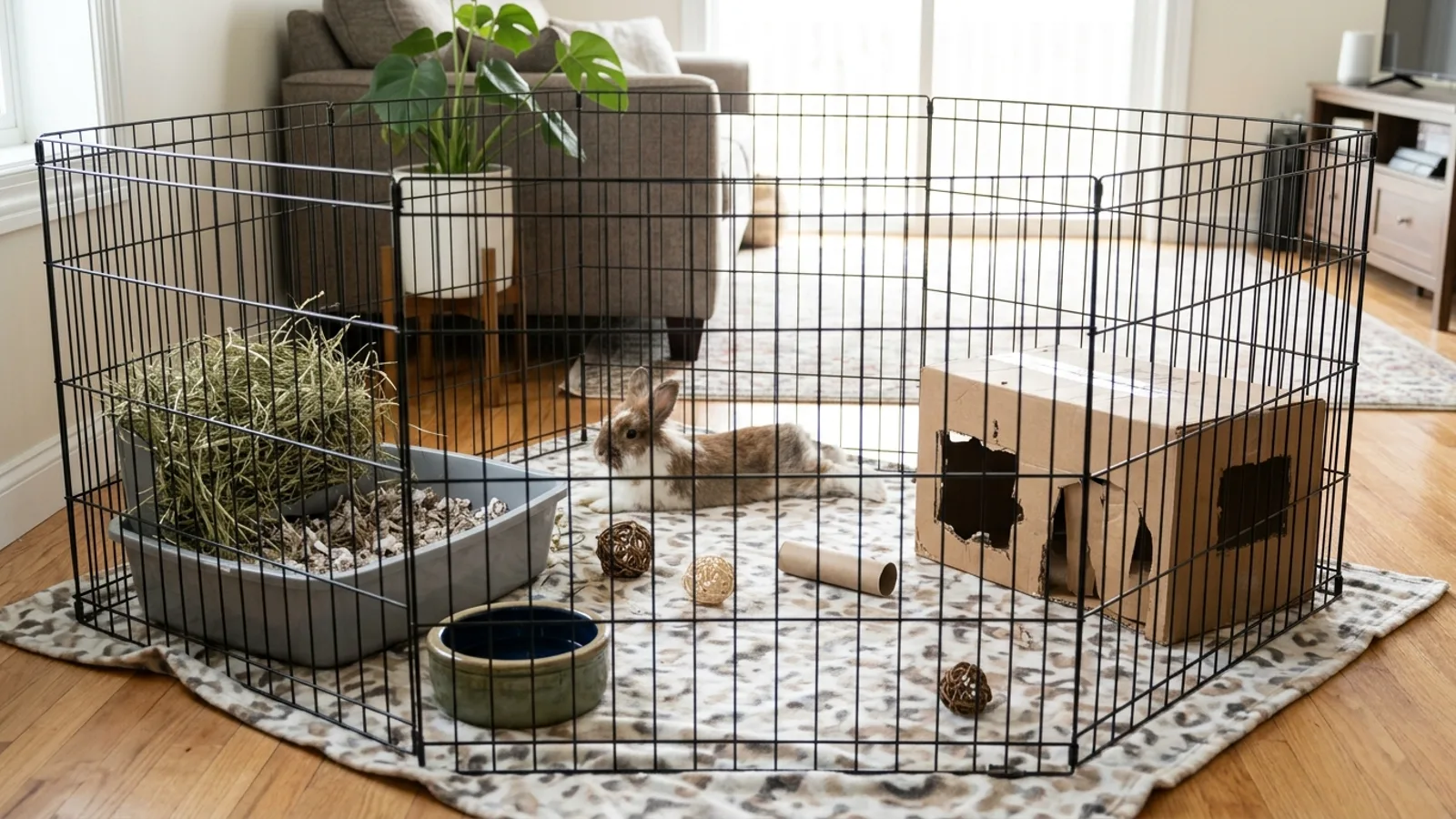
How tall should a rabbit exercise pen be?
San Diego HRS's rule is simple: the pen must be tall enough that your rabbit can't jump over it, or it needs a lid. For escape artists it suggests a removable top, made from shade cloth or bought from the pen maker. Rabbit.org notes that older rabbits who no longer jump high may manage with a single low panel height.
Watch the gaps as well as the height. San Diego HRS suggests reinforcing pen bars with smaller-spaced grids for small rabbits, and the Rabbit Welfare Association advises covering the bars of puppy pens with mesh so a rabbit can't trap a leg or head.
Choosing the right flooring
A pen sits on your floor, so the floor is part of the pen. San Diego HRS says to cover the area under the x-pen with a non-slippery surface: area rugs, carpet squares, towels, blankets or sheets, with a heavy-duty shower curtain underneath as a leak-proof barrier. The RSPCA says floors should be solid and non-slip, and that shiny laminate, polished wood and tiles should be covered.
On carpet, Rabbit.org suggests putting the pen on linoleum or a chair mat, or laying a small tarp or sheet underneath to catch debris. The Rabbit Welfare Association warns that some carpets can burn rabbits' feet and suggests covering them with a blanket or a lino offcut.
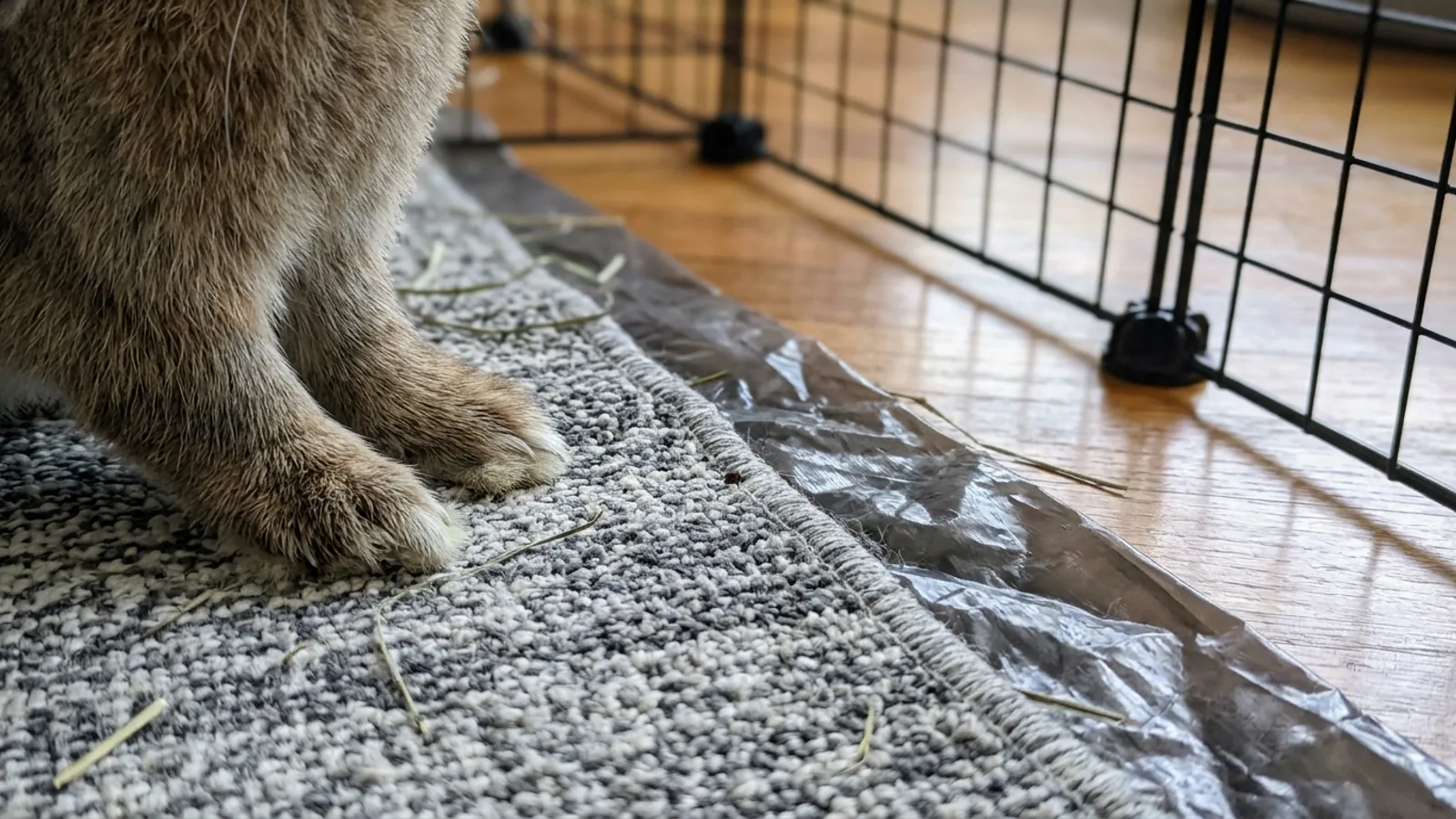
How to set up an indoor rabbit pen in 6 steps
- Pick the spot. The RSPCA recommends a quiet room away from noisy appliances, at 10–20°C (50–68°F), away from draughts and radiators. Out of direct sun, but somewhere your rabbit sees people.
- Lay the floor first. Waterproof layer, then a washable non-slip surface a little larger than the pen.
- Build the pen with the gate where you can reach it easily. San Diego HRS suggests a gate that opens to the side, not downwards, so feet don't get caught, and one big enough for a large litter box to fit through.
- Add the litter tray and hay. The Rabbit Welfare Association recommends hay beside the tray and non-clumping litter, avoiding clay and pine. Our guide to safe foods for rabbits explains why hay matters so much.
- Add hides. The RSPCA suggests one hide per rabbit plus one extra, each with more than one opening.
- Add water and enrichment — a heavy bowl or bottle, chew toys and a digging box — without filling so much floor that your rabbit can't move freely.
The RSPCA advises letting a new rabbit settle in its enclosure for at least 48 hours before it explores further.
Outdoor rabbit pens: extra rules
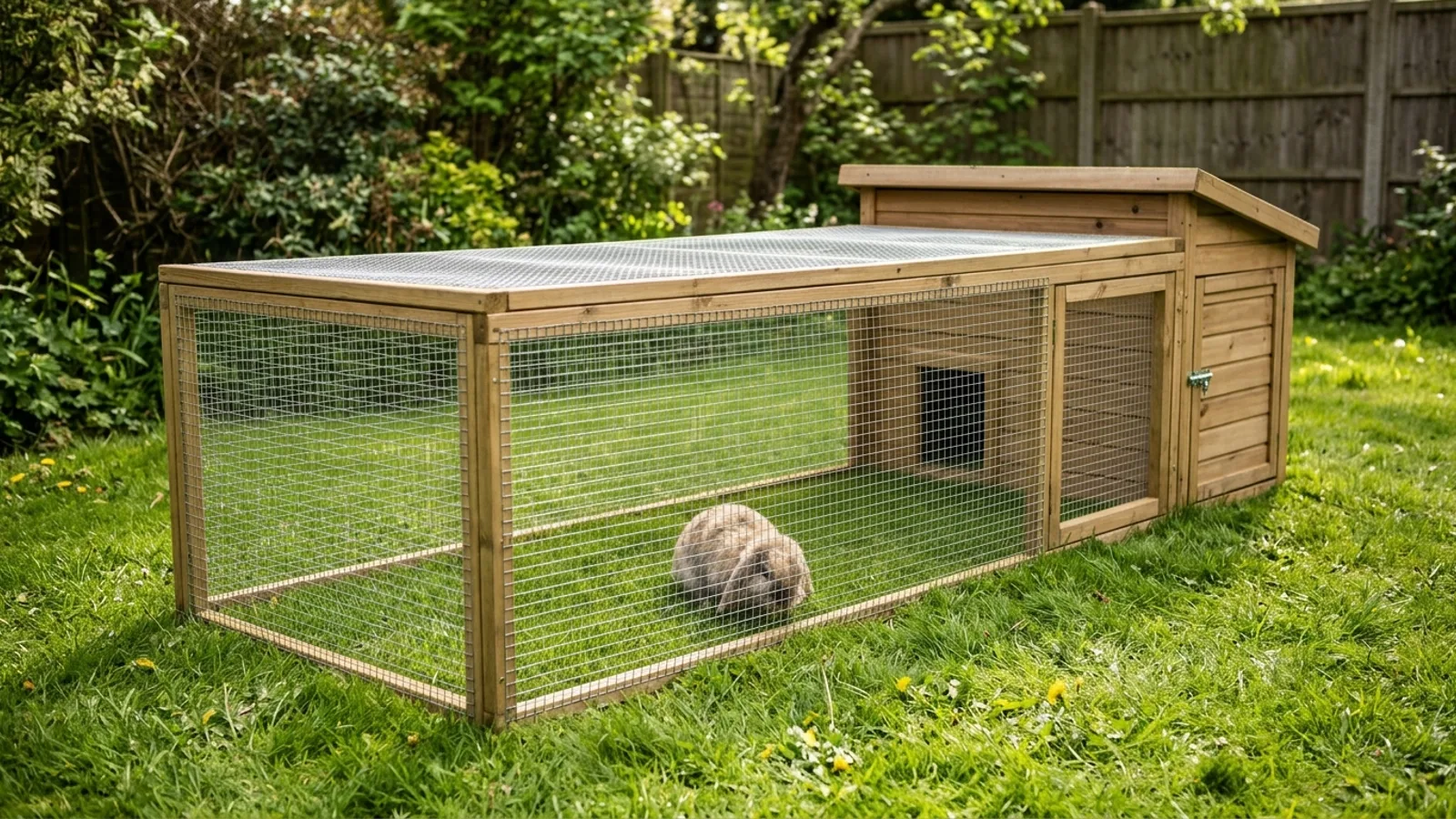
An x-pen on the lawn is not a safe outdoor home on its own. Rabbit.org's guide to outdoor exercise set-ups names dogs, raccoons and other predators as threats, warns that even a large rabbit can squeeze through a surprisingly small opening, and notes that a persistent rabbit can nudge a standard 8-panel pen out of place. Its examples use runs covered on all sides with 1-inch welded wire, and supervision by an adult in open play yards.
The RSPCA adds that outdoor exercise is only suitable in good weather, with plenty of shade once temperatures approach 20°C (68°F) or it is sunny, and that any wire base on a run should be buried and covered with soil and grass. Keep the area free of pesticides and toxic plants; our guide to tomato plants and rabbits lists common garden plants to fence off.
Common mistakes with rabbit pens
- Cables within reach. The Rabbit Welfare Association suggests covering exposed cables with cable protector or hosepipe.
- Houseplants near the pen. The same group advises assuming all houseplants are poisonous.
- A pen that's too low for a young, bouncy rabbit. Add a lid or taller panels.
- Bare, slippery floors that make rabbits skid and struggle to grip.
- Too much furniture. Hides and toys are good, but leave open floor for hopping.
Frequently asked questions
Is a pen better than a cage for a rabbit?
For space, yes. San Diego HRS recommends an x-pen over a cage because it gives more room for the same money. Many owners use both: the cage as a bedroom, with its door open into the pen.
Can a rabbit live in an x pen full time?
Yes, if it is big enough, has everything your rabbit needs inside, and your rabbit gets extra exercise time when possible. The bigger the pen, the closer it gets to the 3m x 2m standards above.
Can rabbits jump out of a pen?
Some can. If your rabbit gets over the panels, San Diego HRS suggests a removable top made from shade cloth or bought from the pen maker.
What do you put on the floor of a rabbit pen?
A non-slip, washable surface such as rugs, carpet squares or blankets, with a heavy-duty shower curtain underneath as a waterproof layer, as San Diego HRS suggests.
The takeaway
A good rabbit pen starts at 4 x 4 feet and grows from there, is tall enough (or lidded) to stop escapes, sits on a non-slip floor, and holds a litter tray, hay, water and a hide with room to spare. Your next step: measure the space you have, then use the panel count above to work out how big a pen will fit.