Rabbit Proofing Your Home: A Room-by-Room Safety Guide
Rabbit proofing your home means doing three things before your rabbit roams free: protecting what can hurt it (cables, toxic plants, hot appliances), protecting what it will chew (baseboards, furniture legs, books), and giving it something better to chew instead. Rabbits chew and dig by nature, so the aim is not to stop that but to point it somewhere safe.
You don't have to do the whole house at once. Rescue groups such as Best Friends suggest starting with one room, making it safe, and adding more space later. This guide walks through the hazards in order of importance, then gives you a 7-step plan and a room-by-room checklist.
Start with one room
Best Friends Animal Society names the bathroom, laundry room, kitchen and bedroom as the rooms that are usually easiest to make safe, and suggests keeping rooms full of hazards, like a computer room with exposed wires, off-limits. It also says to inspect any area carefully before giving your rabbit the run of it, and to keep your rabbit in a safe, bunny-proofed space when you can't supervise.
A good first room has few cables, little wooden furniture and a door or gate you can close. If your rabbit already lives in an exercise pen, put the pen in that room and open it up for supervised play. Our rabbit pen guide covers setting up that home base.
Cables and cords: the most important job
Chewed wires are the biggest danger in bunny proofing. The San Diego House Rabbit Society says to protect all light, power, telephone and other cords, because a rabbit that bites through one can be shocked, and high voltage can kill. It also warns not to hide live cords under rugs, which is a fire hazard.
You have a few options, and they work best combined:
| Option | How it works | Best for |
|---|---|---|
| Move or block | Rabbit.org suggests putting furniture in front of outlets, which hides the wiring too | TV and computer corners |
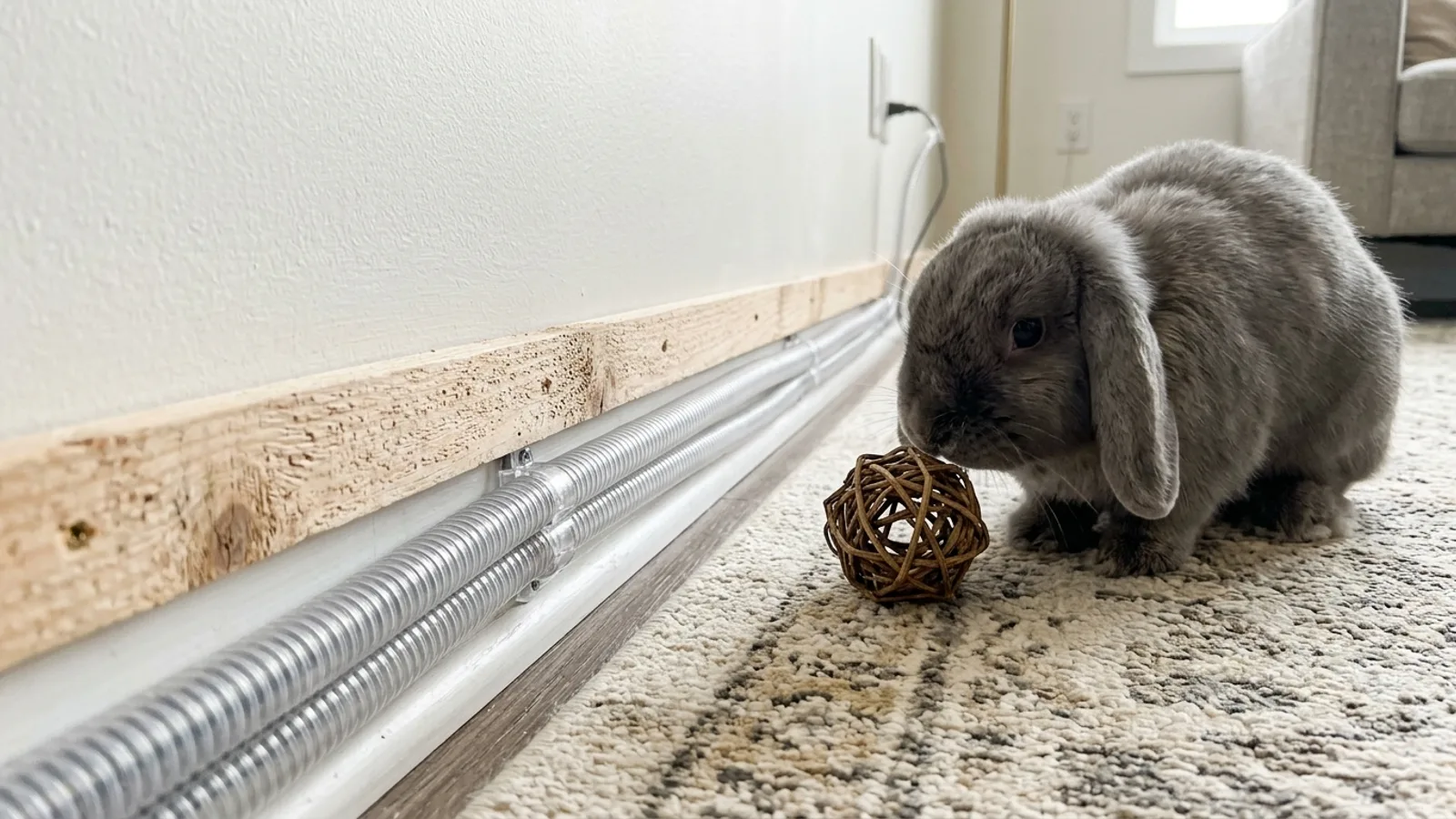
| Plastic tubing | Hardware-store tubing slit lengthwise with a utility knife, cord pushed inside; split loom is ready-cut | Lamp and charger cords that must stay on the floor |
| Cable protector or hosepipe | The Rabbit Welfare Association suggests cable protector, or hosepipe as a less tidy option | Longer runs along a wall |
| Tape it up | Best Friends suggests taping some wires to the wall out of reach | Light cables you rarely move |
Covers slow a rabbit down; they don't make a cord chew-proof. Check them for tooth marks every week, and unplug anything you don't need in that room. Best Friends reminds owners to look for hidden wires under beds and behind furniture, the places a rabbit likes to explore first.
Baseboards, furniture and door frames
The Rabbit Welfare Association & Fund lists door frames, skirting boards (baseboards) and the wooden legs of chairs and tables as rabbit favourites. Its advice is simple: either block access or give plenty of rabbit-safe alternatives. Ways to block access:
- Baseboards: Rabbit.org suggests tacking thin strips of untreated wood (furring strips) onto them as a chew block, and covering the wall above with 24-inch Plexiglas sheets where needed. Best Friends adds that plastic corner protectors from a hardware store can cover chewed corners and window frames.
- Chair and table legs: Best Friends suggests wrapping them in cardboard.
- Sofas and beds: rabbit.org suggests throwing a blanket over upholstery to protect it from teeth and claws.
- Books and magazines: rabbit.org and San Diego HRS both say to move them off the lower shelves.
Bitter-tasting sprays from pet stores can help, but Best Friends notes that some rabbits actually like the taste. Rabbit.org says to check that anything you spray on furniture is safe to breathe in or chew.
Houseplants and other hidden dangers
San Diego HRS warns that many common houseplants are poisonous to rabbits and can cause death. The Rabbit Welfare Association goes further: because so many are toxic, the only safe approach is to assume they all are. Move plants well out of reach, remembering that rabbits climb onto sofas and chairs, and move any plant that drops leaves or flowers to a room your rabbit doesn't use. Our guide to safe foods for rabbits covers what your rabbit should be nibbling instead.
The Rabbit Welfare Association also lists these risks:
- Hot irons, hair straighteners and lit candles.
- Rooms that heat up fast, such as conservatories in summer.
- Other pets in the house.
- Burglar alarm sensors your rabbit could set off while you're out.
Floors, gaps and escape routes
Rabbits have furry feet with no pads, so the Rabbit Welfare Association says they slip on smooth floors; it suggests non-slip mats, carpet tiles or runners. If your rabbit chews or digs at carpet, rabbit.org suggests chair mats over the problem areas, and San Diego HRS suggests carpet squares or washable throw rugs over spots where your rabbit digs, chews or pees.
Check for gaps at rabbit height. The Rabbit Welfare Association warns that rabbits squeeze into the smallest spaces, slip through surprisingly narrow gaps in baby gates and dog gates, and can jump very high. Watch for open front doors and windows, and for jumps off high furniture.
Give your rabbit something better to chew
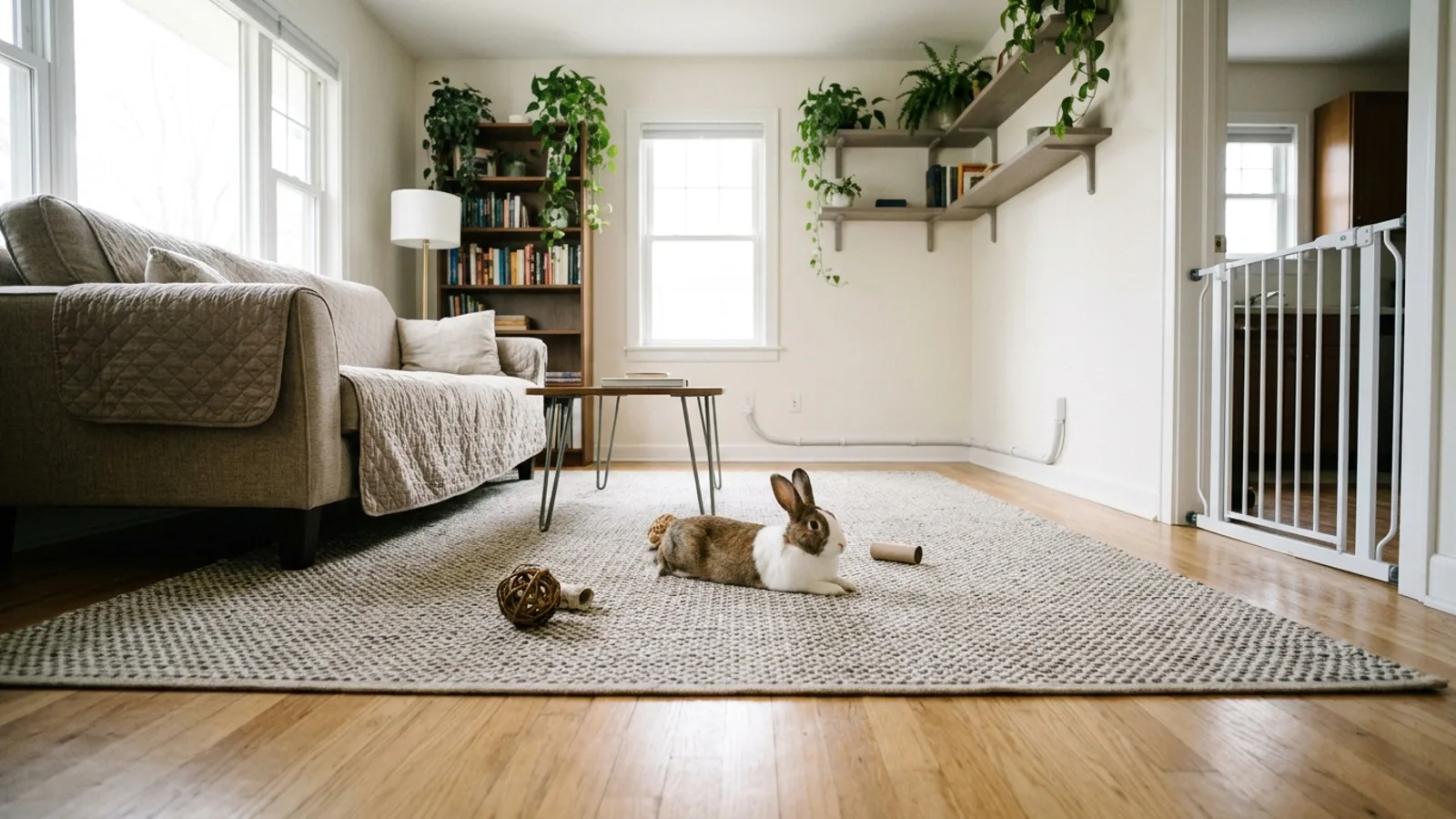
Rabbit.org calls exercise, toys and an interesting space the most rewarding way to prevent damage. A rabbit with nothing to do will find its own projects. San Diego HRS suggests:
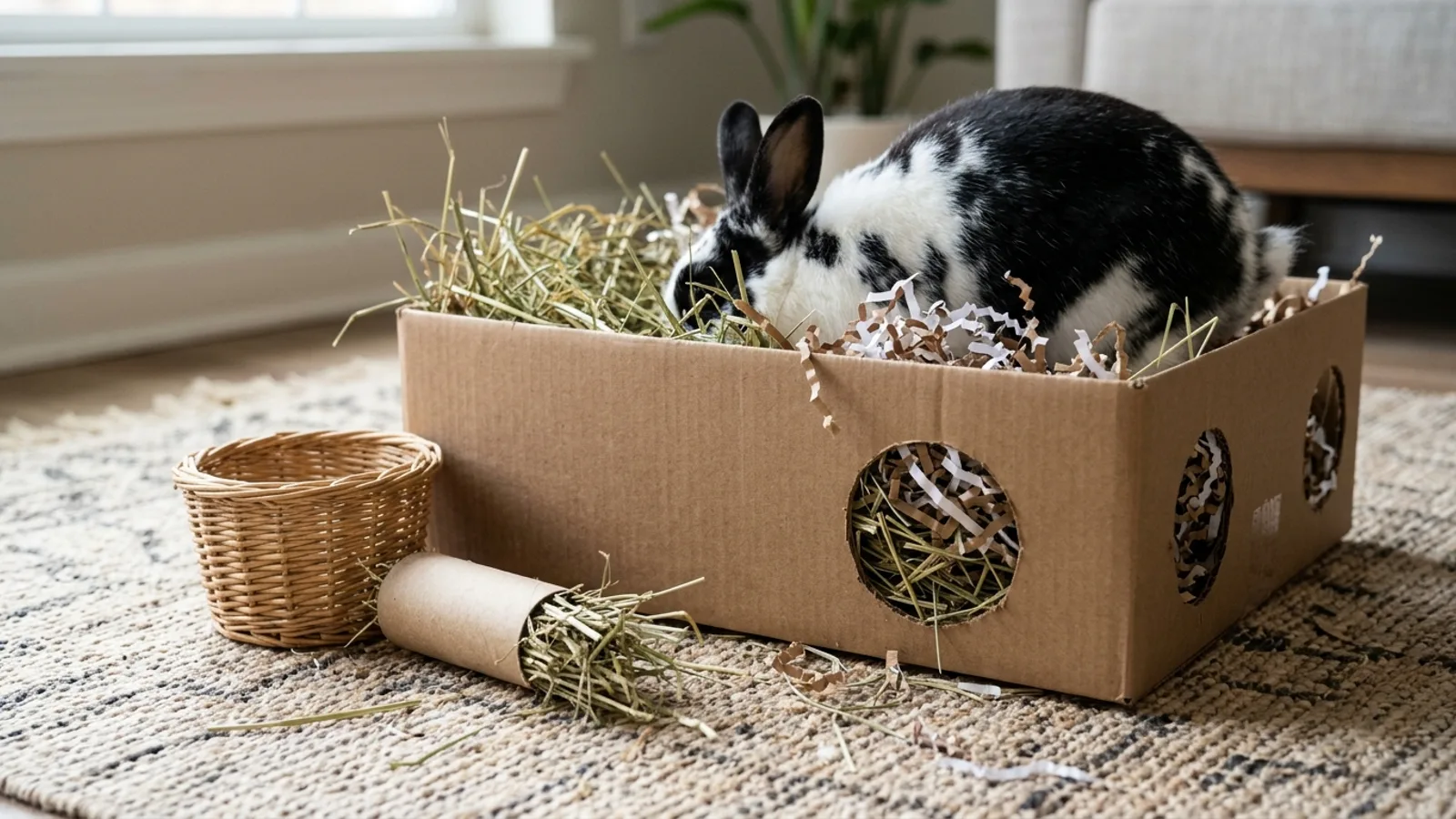
- A cardboard box with a hole cut in each end, filled with hay or shredded paper for digging.
- Pet-safe wicker baskets, chew rings and hay-filled balls.
- Toilet paper or paper towel tubes stuffed with hay.
Best Friends says chew toys should be natural and untreated, and to avoid plywood, particle board, pressboard and pressure-treated wood. Put chews right next to the things your rabbit has started on. If you want to know why your rabbit chews, digs or flops, our guide to bunny behavior explains what each habit means.
How to rabbit proof a room in 7 steps
- Get down to rabbit height. Lie on the floor and look at the room from 6 inches up. Note every cable, gap, plant and wooden edge you can reach.
- Remove what you can. Unplug and take out cables you don't need, move plants and books up high or out of the room, and put away anything hot.
- Cover the cords that stay. Tubing, cable protector or furniture in front of the outlet.
- Protect wood. Furring strips or corner guards on baseboards, cardboard around chair legs, throws on upholstery.
- Block gaps and exits. Behind the sofa and fridge, under the bed, between gate bars, open doors and windows.
- Lay non-slip flooring where your rabbit will run, and add a litter tray and hay. San Diego HRS suggests an extra litter box while your rabbit explores new space.
- Add the alternatives and supervise. Put out chews and a dig box, then watch the first sessions closely. The Rabbit Welfare Association says to supervise rabbits at all times while they run free in the house.
Room-by-room checklist
- Living room: TV and charger cables, sofa underside, recliner mechanisms, houseplants, lower bookshelves.
- Bedroom: cables under the bed and bedside tables, phone chargers, the gap under the bed.
- Kitchen: gaps behind and under appliances, cabinet edges, cleaning products in low cupboards, food dropped on the floor.
- Bathroom: cleaning products, toilet lid down, hair straighteners and their cords.
- Hallway: front door, shoes and bags, gate gaps.
Frequently asked questions
How do I stop my rabbit chewing baseboards?
Block the baseboard and give a better option. Rabbit.org suggests strips of untreated wood tacked on as a chew block; put a chew toy or dig box next to the favourite spot.
Do bitter sprays stop rabbits chewing?
Sometimes. Best Friends notes that some rabbits like the taste, and rabbit.org says to check any spray is safe to breathe in or chew. Treat sprays as a backup, not the plan.
Can I leave my rabbit free roaming when I'm out?
Only when bunny proofing your home is complete for the space your rabbit can reach. Best Friends advises keeping your rabbit in a safe, bunny-proof area when you can't supervise, such as a pen, and the Rabbit Welfare Association says to supervise free-running rabbits at all times.
What houseplants are safe for rabbits?
Play it safe and keep all of them out of reach. The Rabbit Welfare Association advises assuming every houseplant is poisonous to rabbits.
The takeaway
Rabbit proofing your home comes down to covering cables, guarding wood, lifting plants and closing gaps, then giving your rabbit better things to chew. Your next step: pick one room, lie on the floor, and work through the 7 steps above before your rabbit's first supervised run.